
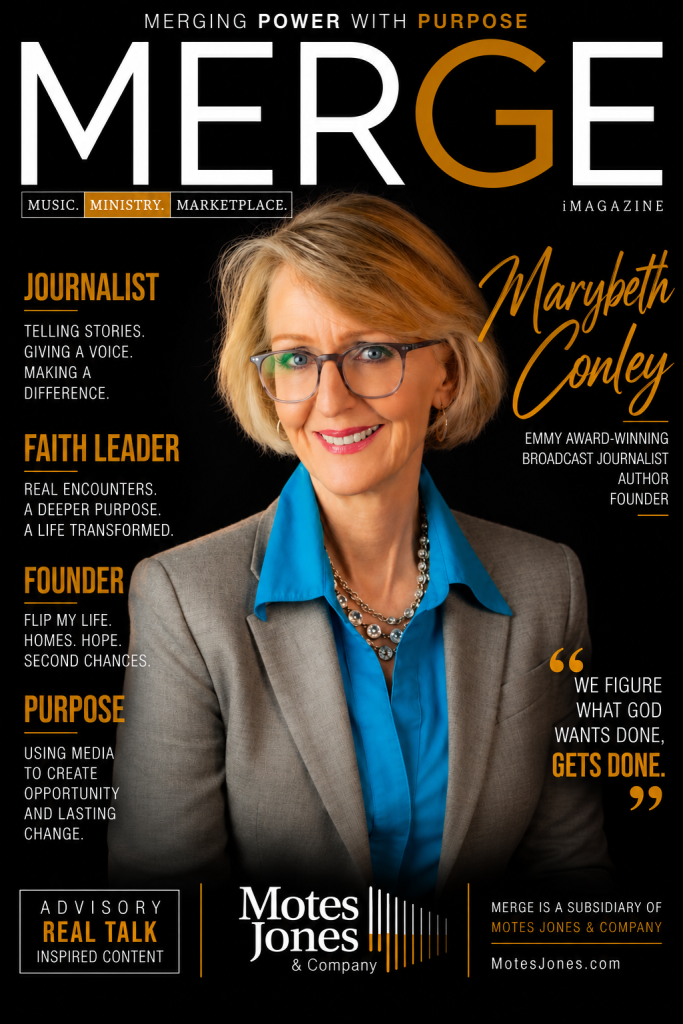
MERGE iMagazine Exclusive Feature:
MARYBETH CONLEY
Faith. Purpose. Restoration.
Interview and Editorial Feature by Sherri D. Motes Jones
Senior Editor | MERGE iMagazine
For nearly four decades, Marybeth Conley was a familiar and trusted presence in Memphis television. As an Emmy Award-winning journalist, news anchor, and consumer investigator with WREG-TV News Channel 3, she built a career rooted in storytelling, credibility, and community connection.
But behind the cameras was a story viewers never saw.
There were years of personal struggles, a growing desire to escape the very career that had brought her professional success, and a spiritual awakening that would change the way she understood her life.
What followed was an extraordinary journey involving an unexpected reunion, a love story decades in the making, and a vision that would connect her broadcasting experience to a mission centered on restoration and second chances.
That vision became Flip My Life.
For Marybeth, the journey has been about much more than creating a television program. It has been about discovering how personal experiences, professional gifts, and faith can intersect to serve a greater purpose.
In this MERGE exclusive, Marybeth shares the deeply personal story behind that discovery.
01 | BEHIND THE CAMERA
The woman behind the familiar face.
MERGE: Before we talk about your broadcasting career and the vision for Flip My Life, take us behind the cameras. What was happening in your personal life that the public never saw?
MARYBETH CONLEY: Flip my Life came to fruition in 2023, but its roots are in the chaos that began in my family twenty years earlier, in 2003. I had three children from 14 to 10 and was pregnant with my fourth. Looking back I feel that I failed them all. The one thing I had always wanted was to be a mom, and create the kind of large, happy family that I grew up in. So when my oldest child began exhibiting anger and behavioral problems I felt like a failure. I realize in retrospect that it was pride that kept me from confiding in the one person who could have advised me well: my mom. I know the one piece of advice she would have given me is that my husband and I had to be on the same page with regard to our son. We were not, and as a result, my son came to view me as the enemy and his father as his champion. I was the target of his anger, was largely unprotected by my husband and over the next 15 years slowly withdrew emotionally from our marriage.
As time went on, I started putting on a mask every day, pretending that I was happy and doing well. Regardless of what might be going on in my life, I had to be ‘on’ every moment of the day: I had to be either that pleasant morning-TV girl or a functional mother to my three other kids, particularly my daughter, who was born into this situation and truthfully never knew what a happy home felt like.
My husband and I developed the unhealthy pattern where I would take the baby out of the house when our son would begin to lose control. My two middle sons would escape to the third-floor playroom. And my husband would calm our son down by patiently listening – but never challenging – his sometimes-irrational litany of complaints at the world’s treatment of him. Patience is a virtue, but when irrational beliefs go unchallenged, they become truth to the person who holds them. It was enabling rather than helping our son.
I cannot explain why I didn’t address the situation better; all I can say is that I was completely overwhelmed. Somehow I convinced myself that the real problem was that I worked in TV, with constant deadlines and pressure to put on a happy face whether I was on air or in the grocery store. I told myself if I could just get out of the TV business, I wouldn’t have to pretend all the time…and I wouldn’t be so unhappy all the time. As clueless as it sounds, I never examined the root of my unhappiness.
“As time went on, I started putting on a mask every day, pretending that I was happy and doing well.”
— Marybeth Conley
02 | REACHING FOR GOD
When success could no longer substitute for peace.
MERGE: You were carrying so much privately while continuing to show up professionally. When did you reach the point where you began searching for something deeper?
MARYBETH CONLEY: By the fall 2009 I was so desperate I did something I had never thought about doing…and I wasn’t at all sure would work.
I reached for God.
I was 50 years old and had always had plenty of ‘religion’ and an intellectual belief in God…but I’d never built a relationship, and I wasn’t even sure He was relevant to my life.
But in a random encounter I met a woman who had given up considerable career success to follow God’s calling to the mission field, and I didn’t understand why she was so happy with her situation. Her simple answer to that question began with an almost surreal look of peace:
“God told me to, and the only place you’ll find peace if when you’re where He purposed you to be”.
I desperately wanted peace, and I had already decided that I might find it if I could just escape TV and drop that ‘happy mask’ …. so I asked her how I would go about finding out where God wanted me.
The next morning I began to follow the blueprint she’d given me: I got up an hour earlier than normal, asked God what I was supposed to be doing in my life, and then, as she had put it, I ‘got into the Word’. That was not a phrase with which I was familiar but she told me it meant I should read the Bible. So for the first time ever, I opened it.
Three weeks later I was getting an hour less sleep a day, I was stuck in ‘Numbers’, and God hadn’t told me a thing. I was not at all happy with Him. And I definitely wasn’t getting much out of reading ‘Numbers’.
“I reached for God.”
— Marybeth Conley
03 | THE MOMENT EVERYTHING CHANGED
An airplane conversation. A book. An encounter she could not explain.
MERGE: You describe an extraordinary experience involving a book called Sit, Walk, Stand. Tell us what happened and why that moment became so significant in your faith journey.
MARYBETH CONLEY: Meanwhile, my Dad broke his hip and entered hospice across the state, so I got on a plane to say goodbye. I had one hour without kids or TV viewers, and a novel in my hand. The last thing I wanted was conversation. But the man in the middle seat was beginning a ‘getting to know you’ conversation and told me he was a pastor who had been called away from his congregation to travel from church to church, wherever he was needed, to help people ‘get into the Word’.
When I heard that phrase, I put down my novel and told him I was trying to do that myself and I was irritated that it wasn’t working. I wanted to know what I was doing wrong that God wasn’t talking to me.
Over the course of that conversation, he told me I should have started reading at the New Testament, to which I said ‘who starts a book in the middle?!?’.
He told me to get a book called ‘Sit, Walk, Stand’, written by a Chinese dissident imprisoned for being a Christian – he said it would take me into Ephesians and that from there, God would guide me where I needed to go.
That made no sense to me but I was happy to have a new blueprint. I get to Knoxville, my dad dies, and I had an empty day ahead so I called a woman I knew casually, and suggested lunch. Even as I was calling her, I wondered why I was doing it – we were not close friends and she knew nothing about my struggles.
But as we sat at Panera waiting for our food and making small talk, she suddenly touched my arm and said, ‘When we leave here, do you mind following me to Cedar Bluff bookstore? A couple days ago I was online buying some books and God told me to buy you this book. It came in today and it would save me sending it to Memphis if you don’t mind picking it up today.’
‘It’s called ‘Sit, Walk, Stand’. Have you ever heard of it?’
That was the first time I knew God was real. And that He heard me, and cared. And it changed my life.
Over the next year or two I had several more inexplicable encounters with Him. These were more “Sit, Walk, Stand” moments, not ‘still, small voice’ moments: I suspect He knew I would doubt more subtle encounters. He had to grow my faith first, and over those months I fell in love with Him.
Over the following six years, I became addicted to my early morning time with Him. It was the only peace I had in my day. My family issues had gotten worse, and that hour or 90 minutes in the early morning darkness of my sunroom was the only time I could drop my mask. That time shored me up for the day ahead.
“That was the first time I knew God was real. And that He heard me, and cared. And it changed my life.”
— Marybeth Conley
THE MERGE PERSPECTIVE
There are moments in life that change more than our circumstances. They change our understanding of what is possible.
For Marybeth, that unexpected encounter became the beginning of a relationship with God that would reshape her perspective on everything, including the career she had spent years wanting to leave.
What she once viewed as a source of emotional exhaustion would eventually become connected to a much larger assignment.
04 | THE PURPOSE BEHIND THE PLATFORM
When the career she wanted to leave began to look like preparation.
MERGE: As your faith grew, you began questioning whether your career in television was connected to God’s purpose for your life. How did that realization unfold?
MARYBETH CONLEY: I was still convinced that I was emotionally exhausted because of my public job. My pride over my desire to create a healthy family continued to keep me from acknowledging what was really going on and I was feeling more desperate than ever to get out of the media.
But in early 2015 I also started to have a nagging feeling: I realized I had neither studied nor sought a media career, and in fact, had tried to leave it 30 years earlier, only to be offered such a sweet deal I had to stay. As I thought about the unusual events that started and advanced my media career I saw that doors that would normally have remained closed had opened over and over. And I began to worry that maybe God did all that because He wanted me in TV….and I didn’t love that idea.
By September 2015, however, I was finally was so broken that I promised to do whatever He showed me, even if it had something to do with the media. I admit I did remind Him several times that I really didn’t want it to be media-related… just in case He hadn’t figured that out already.
05 | THE BIRTH OF FLIP MY LIFE
One vision. Three years of waiting. A mission she never expected.
MERGE: Take us back to the beginning of Flip My Life. What was the original vision, and how did it evolve into something much greater?
MARYBETH CONLEY: Three weeks later, in my morning prayer time, I found myself writing the words ‘Flip my Life’ over and over. Over a few days in the same sort of stream-of-consciousness way, I found myself writing out a story line for a TV show, in which I’d take abandoned or foreclosed houses and renovate them for families trapped in generational poverty. It was to be a competition show of sorts, in which teams of two would be put into weekly ‘challenges’ that somehow involved life issues often not taught to people not blessed with stable families. Things like basic financial literacy.
Generational poverty has been a touchpoint of mine since I moved to Memphis in 1985: that was the first time I became aware of the kind of imbedded poverty that seems like an unbreakable fabric of so many lives – so the original idea of Flip my Life should have resonated with me.
But something felt wrong with the idea. I couldn’t identify exactly what but I used that as a reason to put it aside – I told the Lord I knew He’d show me what was missing when the time was right.
That went on for three years; the idea of Flip my Life would come up again every six months or so but I still couldn’t figure out what was wrong with it. So I’d put Him off again.
Until the end of February, 2018. I’ll never forget the odd feeling of insistence one cold morning in my dark sunroom.
It was a clanging in my mind; an overwhelming feeling that said:
‘It’s time to do Flip my Life…but it’s not for families trapped in generational poverty. The houses should go to people returning to the community from prison.’
The issue of criminal justice reform and re-entry had never been my issue, and this was a full year before those issues became a national conversation…. so I told God that was not something I’d ever cared much about. Because I know best.
But it fit. It was as if a puzzle piece I’d been working suddenly clicked into place, and within a couple of weeks, I was on board with the idea.
06 | THE ASSIGNMENT AND THE OBSTACLES
When the vision is bigger than the resources.
MERGE: Even after you understood the direction of the project, you still had some very practical concerns. What stood between the vision and making it happen?
MARYBETH CONLEY: EXCEPT, I was still very intimidated. I gave God all the reasons I was not equipped for this:
- Producing a show of this type is very different from anchoring newscasts.
- I’d always worked in local television, and local TV stations don’t produce programming like this; it’s too expensive.
- I didn’t have contacts at any networks; since I hadn’t ever wanted to work in TV in the first place, why would I network or keep up with former co-workers who might be able to help?
- I had no money.
I had a million reasons why this would not work.
But that insistent voice in my head would not go away, and by mid-March I knew I needed to answer Him. So I told made a deal with God. I said:
“OK. The first step is to produce a pilot. I can handle that part; I have some friends in production who would help me do that cheap. We can worry about finding a way to get the pilot seen later. BUT in order to shoot a pilot: I need:
- A contractor
- with whom I have chemistry (on-air chemistry is not something you can fake or force)
- who would care enough about criminal justice reform to take time away from his business in order to shoot a pilot with me, because I can’t pay him.
When you figure that out, I know you’ll show me and we’ll get started.”
And as suddenly as it had started, that voice in my head disappeared. I was kind of relieved to not think about Flip my Life anymore.
THE MERGE PERSPECTIVE
Marybeth had identified what she believed was necessary to move the vision forward.
She needed more than construction expertise. She needed someone who understood the mission, shared its compassion, and could bring authenticity to the screen.
What she could not have imagined was that the person who met those requirements was already connected to her story, decades before Flip My Life ever entered her mind.
07 | AN UNEXPECTED LOVE STORY
Forty years. Four hundred miles. One remarkable reunion.
MERGE: Your story takes an unexpected turn with someone from your childhood. How did reconnecting with Rick begin?
MARYBETH CONLEY: Fast forward to Memorial Day weekend. My 5 siblings and our families were gathering at my family home in Mascot, TN. I didn’t want to go; I was in such a bad place that I didn’t have the energy to pretend I cared about my siblings’ lives. It was just one more time I would have to wear a mask.
But I went, and on Saturday afternoon I took my 14 year old daughter on a walk around my old neighborhood. As we walked around the circle of houses I told her some of the stories of that close-knit group of neighbors and as we passed the last house on the loop I casually said,
“I used to walk around at night, wishing this boy would come out because I had a big crush on him”.
I don’t remember mentioning his name but apparently I did, because the next day we were driving somewhere and from the backseat she said,
‘I found him, and he’s so old’
Me: ‘What are you talking about?’
She handed me her phone, and there was the Facebook page of my teen-aged crush.
I hadn’t seen him in 33 years; hadn’t had a real conversation with him for more than 40. And even though a persistent life-long memory of mine was the heartsick feeling I had upon seeing his engagement picture in the newspaper in 1978….I didn’t feel any romantic twinges.
What I felt was curiosity.
I felt that because of some prejudices I have:
- His profile and cover shot featured his motorcycle, and I have pre-conceived notions about bikers.
- He’s a middle-aged white guy whom I knew was raised in a very conservative religion.
- He has spent most of his life in East TN – not the most diverse place on the planet.
- His sister had expressed some anti-immigration views on social media.
And in 2018, loud voices in our country seemed to be accepting and at times, promoting racism and nationalism. I had been heartbroken over that for a long while.
So I saw this guy who seemed to fit the mold of the ‘disenfranchised white male’. Yet in both his FB photos he was holding a tiny black girl and I saw love.
And I wanted to know why. I wanted to know how he had stayed nice.
I don’t really understand why I didn’t friend him, because as teenagers we were friends. Instead, over June and July I occasionally went to his FB page to try to figure out who that little girl was to him, and why they loved each other.
Maybe I just needed the hope those pictures gave me, that maybe the world wasn’t as bleak as I was feeling.
At the end of July, the news was filled with stories of the first anniversary of the white nationalists’ rally in Charlottesville. And I couldn’t stand it anymore so I sent a FB message to my old friend.
“Hey Rick! I was in Mascot recently, telling my daughter some stories from the those days….and I just wondered how you are doing !”
My plan was to catch up with an old friend and work my way around to asking who the little girl is. But in his reply to me, as we caught each other up on family, he told me he’d always had the biggest crush on me …….. And I felt my heart lift in my chest, in the exact reverse of the day it fell when I saw his engagement picture in the newspaper 40 years earlier.
- I told myself I was crazy.
- I didn’t know this person.
- I hadn’t seen him in decades.
- I had a family.
- I was 59 years old, and not particularly emotional.
I wasn’t a 13 year old with romantic notions any more.
But I felt like one.
The next morning I called him to continue ‘catching up’ and after a three-hour conversation neither of us was able to concentrate all day.
We talked daily, and on day 10, we met for coffee in Nashville. We sat in the garden at the Opryland Hotel and talked for 12 hours and I felt something I hadn’t felt in so long I almost didn’t recognize it.
I felt joy.
We didn’t really talk about the future, except for the moment it was time to go. Rick told me he knew I was the only one for him; that I’d always been that but that he’d missed his chance. He wanted me to know that no matter what, there would never be anyone else in his life. And I said, ‘Don’t say that; that’s crazy. I’m not available’.
But when I began my drive home, I burst into hysterical tears and realized that I did have a choice. Three of my children were adults. My youngest had spent her entire life watching me be emotionally abused and I realized it would be better for her to see me say ‘no more’.
And I knew that I did not want to be on my death bed knowing I’d walked away from the one person I’d always wanted.
For years I had told my husband I couldn’t live like this, but I’d always stay when he promised to do his part to make things better. This time, however, I made it official. I told him I’d inadvertently opened a door that I just could not close. He didn’t argue; I think he knew our marriage had been over for a long while.
And the morning after, I sat in my prayer chair as usual and began to talk to God.
And that’s when it hit me.
“I felt joy.”
— Marybeth Conley
08 | THE CONTRACTOR, THE CONVICTION & THE CALLING
When two personal journeys became connected to one mission.
MERGE: What happened in that moment? How did you begin connecting Rick’s life with the very vision you had been praying about?
MARYBETH CONLEY: In the first phone conversation Rick and I had, we caught up with the last 40 years of life.
He told me that in the early 90s he began building decks for friends. By the mid-90s, he was renovating houses. By 1999, his ‘side business’ was so big that he quit his job and opened his own construction business.
He’s a contractor.
And in 2008, following the stock market crash, 18 months’ worth of clients began cancelling their contracts. He had no legal obligation to return their down payments, but he felt it was the right thing to do since they were cancelling only because they’d just lost 60% of their savings.
So he had thousands in down payments to return. He had sub-contractors to pay for work on his current projects. He was going through an expensive divorce and a daughter in college, whose mother wasn’t helping to pay for that.
And in a moment when he said he ‘lost his mind’, he took an unloaded bb gun into a bank.
He’s a bank robber.
He confessed and spent 31 months in federal prison in Texas.
And that experience showed him inequities he hadn’t seen up close before: inmates with black and brown skin, who had lesser crimes but longer sentences.
Ex-offenders who had no place to live and no way to make a living once they had served their time, when he was able to begin to rebuild his life without ever checking a box for an apartment or a job.
In our first conversation he told me ‘Prison showed me my white privilege’. He had never been a bigot but like many in less diverse communities, he was ignorant of systemic racism.
That morning in my prayer time, it was as if God said to me,
‘Six months ago you told me that you’d begin Flip my Life if I found you a contractor, with whom you have chemistry, who would care about people coming out of prison.
So what are you going to do now?’
Here’s what I know. God could have answered my prayer by introducing me to any number of contractors right here in Memphis, who had a heart for ex-offenders working to redeem their lives.
But He knew I still wouldn’t have been equipped to produce Flip My Life, because He knew my heart needed healing first. So He reached back 40 years, and across 400 miles, to the one particular contractor who could help Him with that.
The one particular contractor whose personal experience showed him that offenders are not always bad people. Many are good people who did bad things. In other words, they’re us, not ‘them’.
“Many are good people who did bad things. In other words, they’re us, not ‘them’.”
— Marybeth Conley
THE MERGE PERSPECTIVE
This is where Marybeth’s story moves beyond an unexpected reunion.
The woman who had spent decades communicating with television audiences found herself connected to someone whose personal experience offered a deeper understanding of the very people she felt called to serve.
Marybeth brought the storytelling experience.
Rick brought construction expertise and firsthand knowledge of incarceration.
And together, their experiences gave the vision behind Flip My Life a personal foundation.
What Marybeth had once viewed as separate pieces of her life began coming together in a way she had never anticipated.
09 | MORE THAN A RENOVATION SHOW
Restoring homes. Rebuilding lives. Challenging perceptions.
MERGE: What do you want audiences to understand about the greater mission behind Flip My Life?
MARYBETH CONLEY: By telling their stories well, Memphis can be on the forefront of moving our nation to a more restorative criminal justice system. That’s what we plan to do with Flip My Life. Sure, it’s a renovation show, but because a documentary on re-entry issues will draw just viewers who already believe in restorative justice. God doesn’t need us singing to the choir.
So that’s why I know Flip My Life will be successful. Because it’s not our project. Down to the name, it’s God’s.
THE MERGE PERSPECTIVE
At the center of Flip My Life is a belief that restoration involves more than repairing what has been damaged.
A renovated house can provide shelter and stability.
But rebuilding a life requires opportunity, accountability, support, and a community willing to look beyond a person’s past.
Marybeth understands the power of storytelling. She also understands that the audience most in need of hearing a story may not be the audience already searching for it.
That is what makes the renovation format significant.
The homes create a familiar entry point.
The personal stories invite audiences into conversations about incarceration, reentry, and the possibility of redemption.
And the greater purpose reaches far beyond television.
10 | THE LAST WORD
Faith, gratitude, and the courage to follow the assignment.
MERGE: After everything you have experienced, what continues to give you the confidence to pursue this vision?
MARYBETH CONLEY: To be perfectly honest, Rick and I would be happy just hanging out for whatever time we have left on this earth. That’s how it is when you’ve finally gotten the one person you’ve wanted for 50 years.
But we can’t do that because we are so grateful to a God who saw fit to merge our paths, and give us a final inning that has a bit more meaning than that.
We have no idea how Flip My Life will be funded. We have no idea when or how or where it will be broadcast. But over the last few years we’ve had some pretty good fortune just knocking on doors and walking through the ones that open. We figure we’re in pretty good hands if we just let the big guy handle everything else.
We figure what God wants done, gets done.
“We figure what God wants done, gets done.”
— Marybeth Conley
THE MERGE CLOSING EDITORIAL
Beyond the Camera
There are stories that entertain us, stories that inform us, and stories that challenge us to look more closely at our own lives.
Marybeth Conley’s journey does all three.
For decades, she stood before television cameras telling the stories of others. Her professional success made her recognizable, but it was the experiences away from the spotlight that began reshaping her understanding of purpose.
Her story is deeply personal.
It includes painful family circumstances, the emotional weight of maintaining a public image, and the difficult realization that professional success could not provide the peace she was searching for.
It also includes a growing relationship with God, an unexpected reunion with someone from her past, and a vision that connected two very different life experiences to one mission.
What I find especially compelling about Marybeth’s journey is that she does not present herself as someone who always understood the assignment.
She questioned it.
She resisted it.
She reminded God of the things she did not want to do.
And she had a long list of practical reasons why the vision could not work.
That honesty matters.
Because purpose is not always discovered through certainty. Sometimes it emerges through questions, difficult choices, and the willingness to move forward without knowing exactly how everything will unfold.
Marybeth’s story also reminds us that the experiences we would never choose for ourselves can deepen our understanding of the people we are called to serve.
Through Flip My Life, her vision extends beyond renovated houses.
It is about people who deserve the opportunity to rebuild.
It is about challenging assumptions, opening conversations, and recognizing the humanity of individuals whose lives have been affected by incarceration.
And it is about using the platform she spent decades developing to tell stories that may change how others see the world.
At MERGE, we believe meaningful impact happens when faith, experience, and opportunity intersect.
Ministry is not confined to a church building. It can take place through media, business, community initiatives, and the everyday work of helping others find a path forward.
Marybeth’s journey reflects that belief.
The woman who once wanted to escape television began discovering a new reason to use it.
And the story she never expected to tell became connected to a mission she never imagined pursuing.
Sometimes the greatest chapter of our lives begins when we realize that everything we have experienced may have been preparing us for something more.
This is how we MERGE.
MERGE iMAGAZINE
MUSIC. MINISTRY. MARKETPLACE.
MERGING POWER WITH PURPOSE
An Editorial Feature by Sherri D. Motes Jones
MERGE is a subsidiary of Motes Jones & Company
EDITORIAL & PUBLICATION NOTICE
Editorial Note: This feature is based on personal accounts and written materials provided by Marybeth Conley, originally dated March 2022. Statements concerning personal experiences, relationships, and third parties represent the interviewee’s recollections and perspectives. MERGE iMagazine prepared the interview questions, editorial transitions, and commentary. Statements about the development, funding, or broadcast plans of Flip My Life reflect the time of the original account and should not be interpreted as current project updates.
Photographic Credits: Images appear courtesy of their respective rights holders and are used with permission, subject to final permissions confirmation.
Rights & Permissions: © 2026 Motes Jones & Company. All rights reserved in the publication’s original editorial content and design. The featured interviewee and other respective rights holders retain rights to their independently owned contributions. Reproduction, redistribution, or commercial reuse requires permission from the applicable rights holder, except as permitted by law.